How to Use AI Chat Transcripts to Improve SEO Content
 Grzegorz Graczyk10 min read
Keyword tools can tell you that people search for “CRM pricing” or “Shopify integration.” A full chat transcript tells you what they’re really deciding: whether setup will take a week, whether a feature works on their plan, and which alternative they’re comparing.
That context is the payoff. When you use AI chat transcripts to improve SEO content, you can find the questions, objections, and decision criteria that deserve an FAQ, comparison page, buyer guide, or existing-page update. Keyword research still matters. Transcripts give it first-party evidence and commercial context.
The context keyword tools leave out
A single question is useful. The exchange around it is better. This guide focuses on sequential transcript analysis: how the initial question changes through follow-ups, where the answer fails, and what the visitor does next. If you need the broader intake process across forms, site search, support, and chat, use our guide to turning website visitor questions into blog post ideas.
Code each eligible conversation as a sequence rather than a bag of phrases. Record the initial intent, each follow-up, the answer that preceded it, resolution status, and any human escalation. A visitor may begin with a compatibility question, discover a plan limit, and finish by asking about migration. That conversation contains several intents, but its order shows which concern exposed the next one.
Keep separate fields for primary intent and secondary intents so one long exchange doesn’t inflate the apparent demand for every topic it mentions. Flag contradictions too. If the visitor first says price is the concern and later asks three implementation questions, preserve both statements and let the follow-up chain show where the practical friction sits.
For every coded finding, retain a short de-identified evidence excerpt and its conversation ID. Also capture the source page, answer given, outcome, and whether the exchange resolved, continued, or moved to a person. Reviewers can then inspect the evidence behind a cluster instead of trusting an AI-generated label.
Start with a safe, useful transcript set
Begin with a defined window, such as the last 30 days of pre-sales chat. A bounded set is easier to clean, review, and compare later. You also avoid copying years of customer data into another system without a clear purpose.
What counts as an eligible transcript?
Before export, the designated privacy owner must confirm that the collection notice or consent covers the proposed analysis, the analyst has the required account permissions, and the contract permits the data to be processed by the selected AI service. Exclude conversations covered by a deletion request, records subject to restrictions you can’t satisfy, and sensitive categories that aren’t necessary for the editorial purpose.
The owner should also check retention rules and the requirements that apply in the relevant jurisdictions. If eligibility is uncertain, keep the conversation out of the analysis until the appropriate privacy or legal reviewer approves it. Approval should cover both the transcript export and the AI service that will receive the cleaned text.
Remove data the analysis doesn’t need
Strip names, email addresses, payment details, account identifiers, private URLs, and sensitive free-form information before sending transcripts to an AI model. Replace identifiers with neutral labels such as Visitor 17 or Conversation 042.
Obvious identifiers aren’t the only risk. A rare job title, unusual incident, exact date, or distinctive combination of details may allow someone to infer who took part. Contractual duties and sector-specific rules may still apply after cleaning. Run a residual review for indirect identification and sensitive context, then remove, generalize, or exclude details the analysis doesn’t require.
The Federal Trade Commission’s data-security guidance for businesses recommends knowing what personal information you hold, retaining only what you need, protecting it, and disposing of it appropriately. Apply those principles to transcript exports by limiting access and setting a retention period. The FTC guidance is a useful baseline for data minimization and security; it isn’t a complete checklist for every contract, industry, or jurisdiction.
Keep the context that drives editorial decisions
De-identification shouldn’t flatten the conversation. Store a structured record with the conversation ID, date, source page, audience stage, cleaned wording, answer, follow-up, handoff status, and outcome. Keep the raw transcript in its governed source system and give the editorial team only the fields it needs.
Count unique conversations rather than individual messages. One confused visitor can send eight messages about the same issue; that’s one case with high friction, not eight independent signals of demand.
Use AI to extract decisions, not just keywords
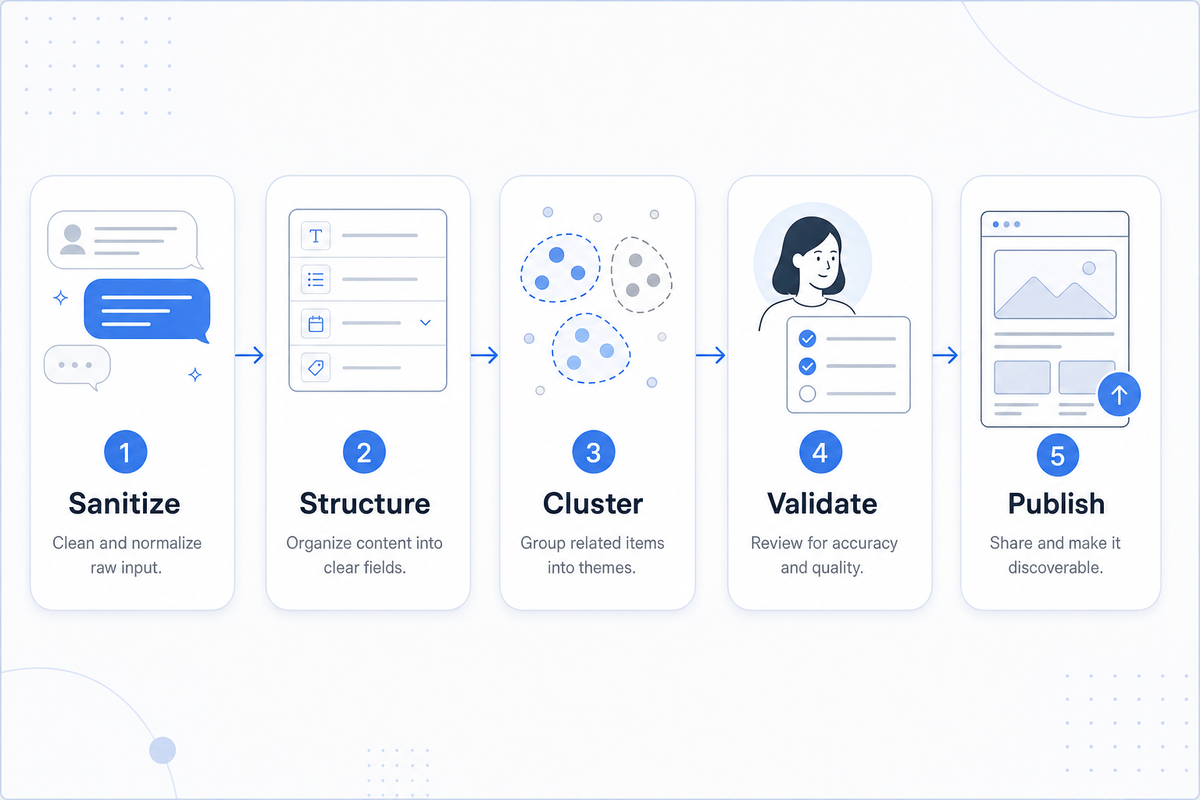
“Summarize these chats” is too loose a request. The model may produce polished themes while hiding weak evidence. Give it a taxonomy, a required output structure, and permission to say that the evidence is insufficient.
What to extract
For each transcript, ask for the initial question, underlying task or decision, objections, comparison criteria, constraints, named alternatives, follow-up chain, apparent answer gap, and conversation outcome. Require a transcript ID and a short supporting excerpt for every finding.
Then ask the model to cluster semantically similar needs. “Can I cancel whenever?” and “Do you require an annual contract?” may belong to a subscription-commitment cluster. Preserve both original phrases. They can later inform headings, examples, and related questions without forcing awkward keyword variants into the copy.
A reusable analysis prompt
Prompt: Analyze the de-identified transcripts below. Group conversations by the customer decision or task they reveal. For each cluster, return: normalized need, original phrases, transcript IDs, source pages, audience stage, objections, comparison criteria, unresolved follow-ups, outcome, and number of unique conversations. Do not infer product facts or intent that the text does not support. Mark uncertain fields “insufficient evidence.” Recommend one candidate destination: FAQ, comparison page, buyer guide, knowledge-base article, existing-page update, or private agent guidance.
AI is useful here for classification and structure. Google’s guidance on generative AI content still puts accuracy, quality, and relevance at the center of publication. A model-generated cluster needs human review before it becomes a claim or assignment.
Validate each cluster before it becomes an assignment
A recurring phrase isn’t automatically a new keyword target. Evaluate each cluster on four factors, scored from 0 to 2:
Frequency: Does it appear once, occasionally, or across several unique conversations?
Friction: Is it casual curiosity, a source of repeated follow-up, or a blocker to purchase or task completion?
Coverage gap: Is the answer clear, buried, incomplete, or absent?
Answer confidence: Is there an approved, stable answer that can be published?
The total orders your review queue. It doesn’t predict rankings. A question asked three times by qualified prospects may deserve attention before a beginner question asked 20 times if the latter already has a clear answer.
Check search intent and existing coverage
Search the normalized question and two or three natural variants. Note the dominant format: short answers, product pages, comparison articles, or detailed guides. This tells you what searchers likely expect and whether the topic supports a substantial page.
Next, inspect Google Search Console. Its Performance report lets you review queries and pages alongside clicks, impressions, CTR, and average position. If an existing URL already earns impressions for the same intent, improve that page first. Our SEO content audit checklist provides a fuller framework for choosing between an update, consolidation, redirect, or deletion.
Low reported keyword volume doesn’t erase customer evidence. It does change the expected return. A narrow implementation concern might justify a concise product-page section rather than a 2,000-word article.
Scoring anchors for consistent review
Set the frequency threshold before anyone scores the clusters. Choose a whole number T of at least 3 based on the volume of unique eligible conversations in the review window, record it in the worksheet, and keep it unchanged when comparing periods. Reviewers should score from the evidence excerpts and structured records, then resolve disagreements before ordering the queue.
Factor | 0 points | 1 point | 2 points |
|---|---|---|---|
Frequency | 1 unique conversation | 2 to T − 1 unique conversations | T or more unique conversations |
Friction | No follow-up and no sign that the question blocked the task or decision | One clarifying follow-up, an expressed concern, or an uncertain outcome | Repeated follow-ups, failed task completion, an explicit purchase blocker, or human escalation |
Coverage gap | A direct answer is visible on the source page and matches the approved source | The answer exists but is buried, split across pages, or missing a condition raised in the transcript | No answer exists, or the published answer conflicts with the approved source |
Answer confidence | No current approved source or responsible owner | A source exists, but the designated product, policy, support, or legal owner has not approved the public answer | The designated owner has approved the wording against a named, current source such as product documentation, policy, or plan rules |
Record T, the approving owner, and the source used for answer confidence beside each score. That audit trail makes a later rescoring explainable when conversation volume, product behavior, or policy changes.
Choose the page that resolves the actual need
The best destination follows the depth, stability, and intent of the question. Forcing every cluster into a blog post creates thin pages and leaves conversion friction where it started.
Transcript pattern | Best destination | What to publish |
|---|---|---|
Short, stable question repeated on one decision page | FAQ section | Direct answer, essential condition, and a link to deeper detail |
Prospects repeatedly weigh two products or approaches | Comparison page | Decision criteria, meaningful differences, tradeoffs, and fit |
Questions about compatibility, limits, implementation, cost, risk, or switching | Bottom-funnel buyer page | Scenarios, boundaries, requirements, and the appropriate next step |
Customers need to complete a repeatable task | Knowledge-base article | Prerequisites, ordered steps, expected result, and escalation path |
A question exposes missing information at its source | Product or pricing page update | Clarification placed near the feature, plan, or action involved |
The answer is sensitive, account-specific, or unstable | Private agent guidance | Approved internal response and escalation rules |
FAQ sections
Use an FAQ when the answer is concise, broadly applicable, and unlikely to change without notice. Put it on the page where the uncertainty occurs. A billing question prompted by the pricing table belongs close to that table, not buried in a generic FAQ archive.
Comparison and bottom-funnel pages
A comparison page needs more than one visitor mentioning a competitor. Look for repeated criteria: migration effort, integrations, contract structure, support, or a specific workflow. Address the tradeoffs honestly and state who each option suits.
Bottom-funnel content serves visitors validating fit. Several related questions about setup time, data import, and required access could support one implementation guide. That’s usually more useful than three overlapping posts.
Turn the evidence into a writer-ready brief
The brief should carry the evidence forward without treating the transcript as a source of truth about your product. Customer wording defines the concern. Product owners, documentation, policies, and other approved sources define the answer.
Include the normalized need, original phrases, source-page context, audience stage, verified answer, target query, likely search intent, required subquestions, coverage gap, internal links, intended next action, approver, and review date. Our guide to creating an SEO content brief writers can use explains how to turn those inputs into a practical decision document.
One strong cluster can create several coordinated improvements without creating several URLs. For example, a detailed implementation guide can target the broader search need, while a two-sentence answer on the pricing page resolves the immediate objection. The pages should link naturally and avoid repeating the full answer.
Google’s people-first content guidance asks whether a page provides original information and leaves readers feeling they’ve learned enough to achieve their goal. Transcript evidence contributes the language and follow-ups of an actual audience. Editorial review supplies the accurate, complete answer.
A connected workflow in ProjectHQ
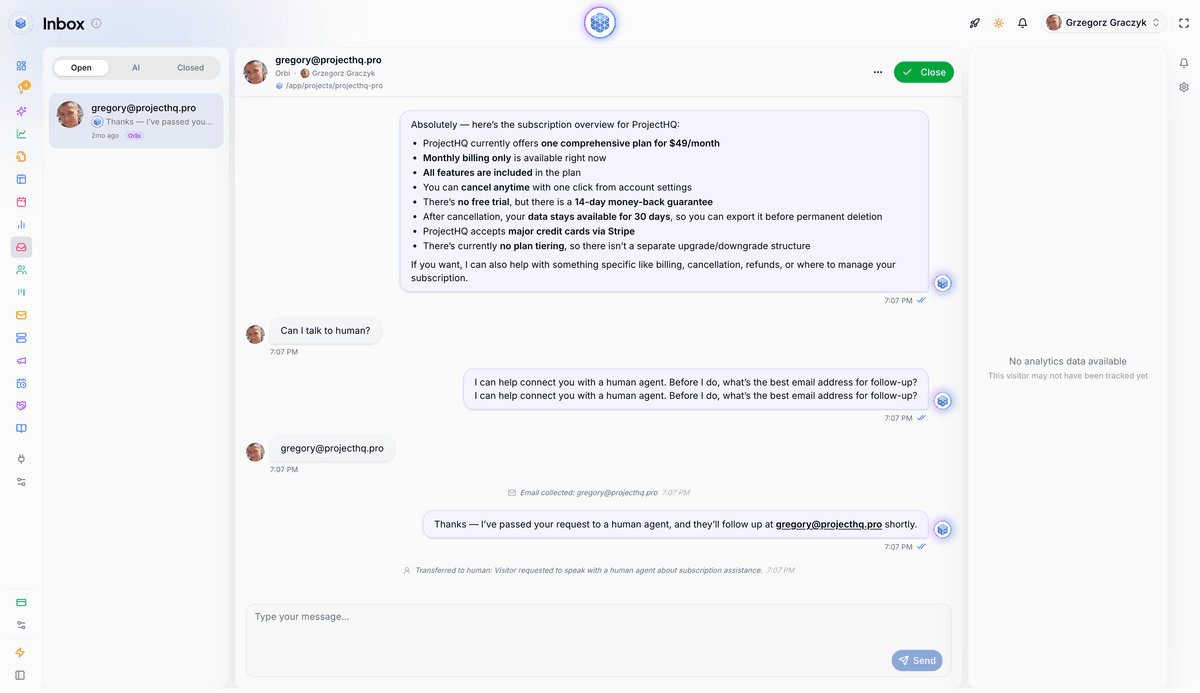
Our Live Chat & AI Assistant is page-aware, keeps conversation history in a unified inbox, and attaches that history to contact profiles. That lets a team review a question alongside the page where it occurred and see whether the exchange continued or moved to a person.
After de-identification and editorial review, an approved cluster can move into our AI Content Creation workflow. There, the team can research keywords, analyze competing pages, create an outline with knowledge-base context, edit the draft, and publish. ProjectHQ keeps the conversation and content work in a connected system; privacy review, prioritization, and factual approval remain team responsibilities.
For the system design behind that handoff, see our guide to connecting AI content, chat, and SEO tools.
Measure whether the content changed the conversation
Track the affected URL in Search Console: impressions, clicks, CTR, average position, and the queries associated with the page. Compare a sensible period before and after the change, allowing for seasonality and low sample sizes.
Pair those search measures with the page’s intended action, such as a product click, signup, or completed support task. Then return to the original conversation cluster. Are fewer visitors asking the basic question? Have follow-ups become narrower? Does the same objection continue on the same page?
Persistent repetition has several possible causes. The answer may be incomplete, placed too far from the decision, written in internal terminology, or difficult to discover. Use the next transcript review to diagnose the remaining gap. One chat or a last-click conversion cannot prove that a page produced revenue, so report search visibility, on-site actions, and conversation changes as related evidence.
Run one 30-day transcript sprint
Take the last 30 days of eligible pre-sales or support chats. De-identify them, extract clusters with the structured prompt, and choose one high-intent need with a verified answer. Validate it against the search results, Search Console, and your existing pages. Then ship one concrete improvement: an FAQ, a refreshed page, or a writer-ready brief.
Assign three owners before scaling: one for evidence quality and privacy, one for answer approval, and one for SEO validation. A small completed loop will show you where the workflow needs adjustment before transcript analysis becomes a recurring part of your content operation.
Grzegorz is the founder of ProjectHQ and has spent 15+ years in SEO — from technical audits to content strategy that ranks. He builds the product he writes about, so the playbooks here come from running real campaigns, not theory.
Ready to grow traffic?
Write SEO-optimized articles and track your rankings with ProjectHQ.
Get started