How to Create an SEO Content Brief That Writers Can Actually Use
 Grzegorz Graczyk14 min read
A good SEO content brief should make a writer’s job easier. In practice, many briefs do the opposite. They dump in a keyword, a suggested word count, a few competitor links, and a vague note to “make it rank.” That may satisfy an internal process, but it does not give a writer the context needed to produce a strong article.
If you want a piece to perform in search and be genuinely useful to readers, the brief has to connect the right things: search intent, SERP expectations, internal linking opportunities, conversion goals, and brand voice. Just as importantly, it has to present that information in a way a writer can use without decoding a spreadsheet full of SEO notes.
This guide explains how to create a practical, writer-friendly SEO brief. Instead of offering a generic template with empty boxes, it shows what each section should actually do, what to include, and what to leave out.
Why most SEO content briefs fail writers
Most failed briefs have the same core problem: they are built around the needs of the SEO team, not the needs of the person writing the draft.
SEO inputs matter, of course. But Google’s guidance emphasizes creating helpful, reliable, people-first content rather than content made primarily to manipulate rankings. In its people-first content guidance, Google explicitly asks whether content leaves readers feeling they have learned enough to achieve their goal. That means a brief cannot stop at the keyword level. It has to help the writer understand what the reader is trying to accomplish and what kind of page will satisfy that need.
When a brief is weak, a few predictable things happen:
The draft misses intent. The writer answers a different question than the one searchers are actually asking.
The article blends into the SERP. It repeats what other pages say without adding real value.
Revisions multiply. Editors have to retrofit internal links, tighten positioning, and correct the angle after the fact.
Conversion goals feel forced. Calls to action get bolted onto articles that were never structured to support them.
A usable brief is not a place to store every scrap of research. It is a decision document. Its job is to clarify the article before drafting begins.
What a usable SEO content brief needs to do
As a practical framework, I recommend that a strong SEO brief accomplish four things at once.
Align the team on the article’s purpose
The brief should make it obvious why this article exists, who it is for, and what outcome counts as success. Rankings may be one outcome, but they are rarely the only one.
Help the writer satisfy search intent
Google’s helpful content guidance asks whether content leaves readers feeling they have learned enough to achieve their goal. A brief should therefore translate search demand into a concrete reader promise: what the article will help someone understand, compare, decide, or do.
Provide guardrails without scripting the article
Writers need direction, not micromanagement. A brief should reduce ambiguity around angle, depth, sources, and constraints, while still leaving room for judgment and original phrasing.
Connect SEO to business context
Search visibility matters, but so do brand consistency, internal linking, and conversion paths. The brief is where those elements come together in a form the writer can act on.
Start with search intent, not just the keyword
If you are learning how to create a content brief for SEO, the biggest upgrade is this: stop treating the keyword as the strategy.
A keyword tells you the topic. Intent tells you what kind of page should exist for that topic.
Identify the dominant intent
Ask what the searcher most likely wants when they type the query. Are they looking for:
Informational content that explains a process
Commercial content that compares tools or approaches
Transactional content that helps them buy or sign up
Mixed intent where users may want both education and options
For a query like “how to create a content brief for seo,” the intent is primarily informational. The searcher wants a method, a structure, and practical guidance. That means a brief for this topic should prioritize clarity and usefulness, not aggressive product pitching.
Turn intent into a reader promise
Once intent is clear, translate it into one sentence the writer can use:
Reader promise: By the end of this article, the reader should know how to build an SEO content brief that is specific enough for writers to use and strategic enough to support rankings and conversions.
That sentence is more useful than a raw keyword because it guides the article’s scope and tone.
Avoid intent mismatch
One of the most common briefing mistakes is asking a writer to rank for an informational keyword while pushing the piece toward a bottom-funnel sales page. That tension usually produces awkward content that satisfies neither searchers nor the business.
Read the SERP like an editor
A writer-friendly brief should reflect what the search results are already teaching you.
You are not reviewing the SERP to copy competitors. You are reviewing it to understand the minimum expectations of the query and identify places where your article can be more useful.
Look for recurring patterns
As you review top-ranking pages, note patterns such as:
Whether the results are step-by-step guides, templates, checklists, or examples
How detailed the pages are
Which subtopics appear repeatedly
Whether the titles emphasize process, templates, mistakes, or examples
How quickly the pages get to actionable advice
Those patterns show what readers and search engines already expect.
Separate table stakes from opportunities
Some topics are non-negotiable. If every strong result explains search intent, outline structure, and internal links, your article probably needs those too. Those are table stakes.
The opportunity comes from the gaps. Maybe the current results are too generic. Maybe they offer templates but not filled examples. Maybe they discuss keywords but ignore conversion goals and brand voice. Those gaps become your angle.
Document the insight, not just the links
A bad brief says, “Read these five competitor articles.” A better one says:
Pattern: Most results are template-heavy but light on practical examples.
Pattern: Writers are told what to include, but not why each field matters.
Opportunity: Create a writer-first framework that integrates intent, SERP patterns, internal links, conversion goals, and voice.
If your workflow includes research and drafting in the same place, that context is easier to preserve. For example, ProjectHQ’s AI Content Creation feature is designed around keyword research, competitor analysis, outline generation, and drafting in one workflow, which naturally fits the briefing stage.
Build the brief around one clear article promise
Before you get into headings, links, or sources, define the article at the highest level.
Include these core fields first
Working title: A clear, useful promise, not a placeholder.
Target audience: Who this piece is for.
Primary intent: Informational, commercial, transactional, or mixed.
Article goal: What the piece should help the reader accomplish.
Primary CTA: The next step, if there is a natural one.
These fields give the writer orientation before they look at tactical instructions.
Define success beyond rankings
Rankings are lagging indicators. A brief should also clarify what success looks like once readers arrive. Depending on the article, that could mean:
High engagement
Strong scroll depth or time on page
Clicks to related resources
Email signups or demo interest
Assisted conversions later in the funnel
That is where analytics becomes important. If you measure visits, traffic sources, and on-site actions, tools such as Website Analytics can help connect the article’s performance to business outcomes rather than rankings alone.
The practical SEO content brief template writers can actually use
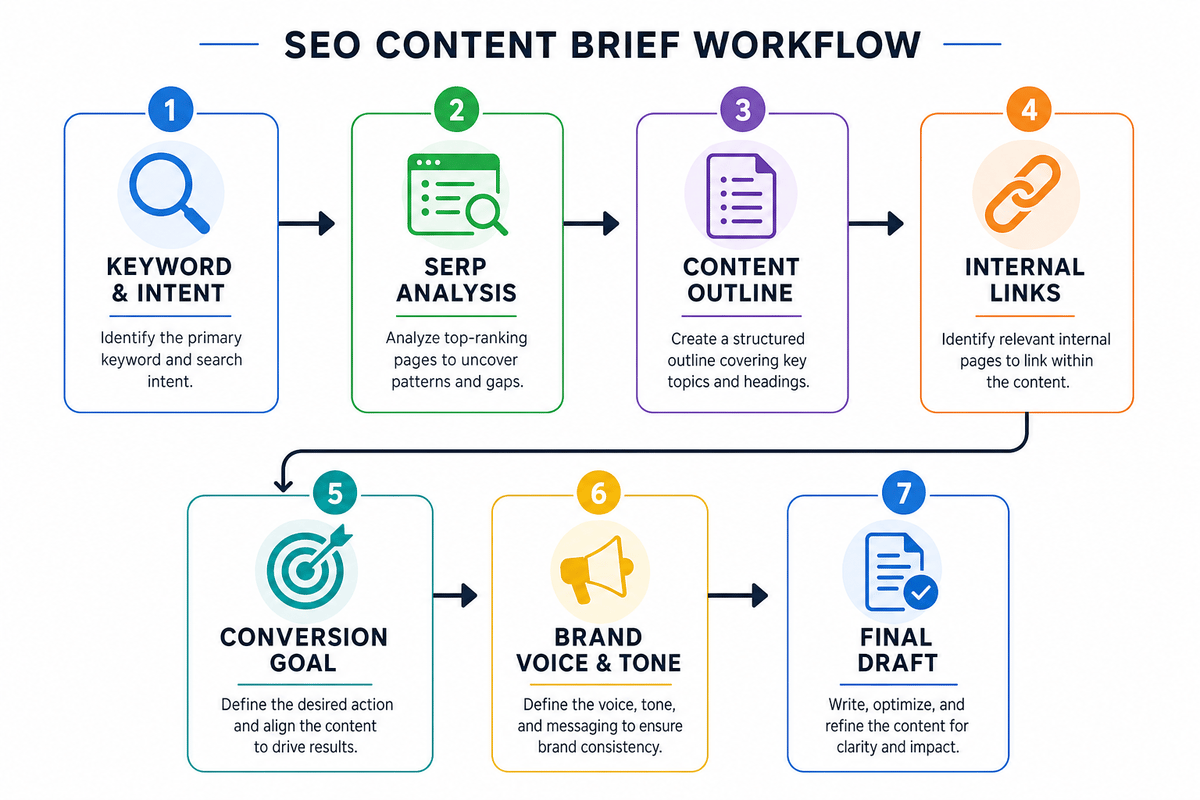
Here is a simple structure I recommend for most informational SEO articles. In my experience, the template works best when each field stays concise and decision-oriented.
1. Article overview
Working title
Primary keyword
Target audience
Search intent
Article goal
This section tells the writer what they are making and for whom.
2. Reader promise
Add one or two sentences that explain what the article must help the reader do, understand, or decide. This is the anchor for every later decision.
3. SERP insights
Dominant result type
Common subtopics
Typical content depth
Weaknesses or gaps in existing results
Angle to differentiate
This gives the writer useful market context without forcing them to reverse-engineer the SERP themselves.
4. Must-cover points
List the essential subtopics the draft needs to address. Keep this to the real must-haves. If everything is mandatory, nothing is prioritized.
5. Recommended outline direction
Provide a preferred structure or sequence, not a rigid script. For example:
Start with why most briefs fail
Explain the role of intent
Break down the brief template
Show a filled example
End with a practical checklist
This reduces structural revisions later.
6. Internal links
As a practical rule of thumb, include a short list of internal pages that genuinely support the article, and note why each one belongs. The exact number can vary by topic, but handing the writer a raw list of URLs is usually less helpful than explaining the role of each link.
7. Supporting sources
List authoritative sources the writer can rely on for factual claims, definitions, or best practices. This supports accuracy and trust.
8. Conversion goal
Primary CTA
Secondary CTA, if relevant
What stage of the funnel this article supports
Keep this realistic. Informational articles should usually educate first and convert naturally second.
9. Brand voice and constraints
Preferred tone
Claims to avoid
Approved terminology
Audience sensitivities
Product facts or positioning notes
This is where the article stops sounding generic and starts sounding like your company.
10. Non-negotiables and watch-outs
End with a short list of things the writer absolutely must do or avoid. Examples:
Do not overuse the keyword unnaturally
Do not promise rankings
Do not force a product mention if it does not fit the section
Use examples, not just abstract advice
That is enough structure to guide the writer without burying them in noise.
How to handle internal links, sources, and conversion goals without cluttering the brief
These are often the messiest parts of a content brief because teams try to stuff too much into them.
Internal links: choose fewer, better links
Google’s SEO Starter Guide explains that links help users and search engines understand how pages relate. That does not mean every article needs a dozen mandatory internal links.
A better approach is to include a short list of links that meet at least one of these tests:
They deepen the reader’s understanding of a point in the article
They offer the natural next step in the journey
They connect to a closely related topic or tool
Sources: support trust, not filler
Supporting sources should exist to improve accuracy and depth. Google’s helpful content guidance stresses creating content people can trust, so instead of listing random blogs, include a few dependable references that help the writer verify claims, definitions, or product facts.
Good source notes are specific. For instance, a brief can point writers to source types such as official Google Search Central documentation, first-party product or policy pages, internal analytics definitions, and original company docs or PDFs in a knowledge base. Concretely:
Use Google’s helpful content guidance when discussing people-first content
Use Google’s SEO guidance when discussing internal linking and site structure
Use first-party product pages for any brand or feature claims
Conversion goals: match the funnel stage
Not every article should push the same action. If the query is top-of-funnel, the brief should usually point to a low-friction next step: a related guide, a product feature page, or a soft signup path.
If you want to refine this over time, analytics and contact data can help you see which content paths actually lead somewhere useful. The important point for the brief is simple: make the CTA fit the reader’s intent.
How to bake brand voice into an SEO brief
Brand voice is where many briefs become vague. Terms like “friendly,” “clear,” or “professional” are too abstract to guide a real draft.
Turn voice into usable instructions
Instead of broad adjectives, give the writer practical direction:
Do: write like an experienced strategist explaining a process clearly.
Do: prefer direct language over jargon.
Do: acknowledge tradeoffs and avoid overpromising.
Don’t: use hypey claims like “guaranteed to rank.”
Don’t: force product mentions into sections where they do not belong.
That is far more actionable than “keep it approachable.”
Include product facts and claims boundaries
If the piece may mention your product, the brief should include what is accurate to say. That matters for both trust and consistency.
For ProjectHQ, verified product claims include features such as AI content creation, keyword and competitor research in the content workflow, a shared knowledge base, rank tracking, analytics, and content planning. What the brief should not do is imply guaranteed rankings or capabilities not supported by the product pages.
Use one source of truth for brand context
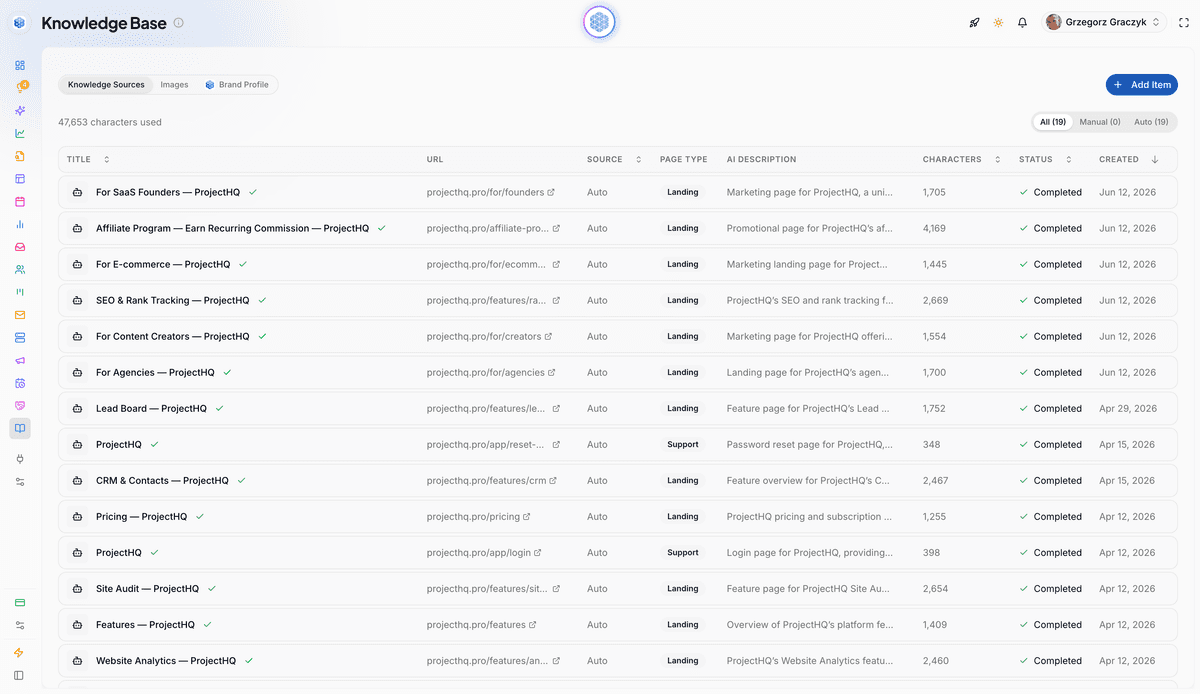
This is where a central knowledge system helps. ProjectHQ’s Knowledge Base is specifically described as the shared source of truth powering its AI features, with brand, product, and company information pulled from URLs, documents, and other sources. In practical terms, that makes it easier to keep briefs and drafts aligned with approved messaging.
When voice guidance, product facts, and terminology live in one place, writers and editors spend less time correcting preventable inconsistencies.
A filled example: brief for “how to create a content brief for seo”
Here is what a concise, usable brief for this exact topic might look like.
Article overview
Working title: How to Create an SEO Content Brief That Writers Can Actually Use
Primary keyword: how to create a content brief for seo
Target audience: content marketers, SEO leads, editors, and founders managing freelance or in-house writers
Intent: informational
Article goal: teach the reader how to build a practical SEO brief that improves draft quality and reduces revisions
Reader promise
By the end of the article, the reader should be able to create a brief that connects keyword strategy, search intent, SERP patterns, internal links, conversion goals, and brand voice in one document a writer can use immediately.
SERP insights
Results likely skew toward templates and beginner how-to guides
Common themes include keyword targeting, competitor analysis, and outlines
Opportunity is to go beyond templates and show a practical writer-first structure
Must-cover points
Why many briefs fail
How to identify and apply search intent
How to read the SERP for patterns and gaps
What sections a usable brief should include
How to handle internal links, sources, and CTAs
How to add brand voice guidance
A filled example
Common mistakes and a final checklist
Internal links
AI Content Creation — use when discussing integrated research and drafting workflows
Knowledge Base — use when discussing brand voice and approved messaging
SEO & Rank Tracking — use when discussing topic prioritization and performance follow-up
Website Analytics — use when discussing article success beyond rankings
Conversion goal
Primary CTA should be soft and relevant: encourage readers to use a connected workflow for research, writing, and measurement rather than forcing a hard sell.
Brand voice
Clear, practical, and experienced
No fluff, no guarantees
Use examples over abstraction
Be honest about where tools help and where editorial judgment is still required
That is enough detail to guide a writer well without overwhelming them.
A quick revision example from the briefing process
One lesson that comes up repeatedly in real editing is that weak briefs often fail because they name a topic without making the reader outcome concrete. For example, an early version of a brief for this topic might say only: "Target keyword: how to create a content brief for seo. Cover templates, competitors, and best practices."
That version gives the writer a topic, but not a usable angle. A stronger revision is: "Reader promise: show content marketers and editors how to build a writer-friendly SEO brief that covers intent, SERP expectations, internal links, sources, conversion goals, and brand voice without turning into a spreadsheet dump."
The difference is small but practical. The revised version makes the audience, scope, and success criteria clearer, which usually reduces avoidable revision cycles later.
Common mistakes that make briefs harder to use
If your briefs are not producing strong first drafts, one of these issues is usually the cause.
Too many keywords
When a brief tries to target every variation at once, the draft often becomes scattered. Start with one primary keyword and a clear topic focus.
Too many mandatory links
Overloading the writer with required links creates awkward prose. Choose the links that genuinely support the article.
Contradictory instructions
Telling a writer to “keep it concise” and “cover everything in depth” is not direction. Neither is asking for an informational article with a transactional CTA in every section.
Word count as fake strategy
Google’s helpful content guidance does not suggest an ideal word count for ranking; the more reliable standard is whether the page provides enough information for readers to achieve their goal. In practice, length should be driven by what the topic needs, not by an arbitrary target alone.
Abstract voice guidance
“Make it sound premium” is not useful. Give concrete do’s and don’ts instead.
No differentiation plan
If the brief only says “cover the topic,” the article will likely resemble everything else already ranking. The brief should state where the article will add value beyond the obvious.
How to streamline the process with one connected workflow
Creating briefs becomes much easier when research, brand context, drafting, and measurement are not scattered across separate tools and documents.
This is one place where ProjectHQ fits the topic naturally. Based on its feature pages, the platform combines:
AI Content Creation for keyword-driven article workflows, competitor analysis, structured outlines, and drafting
Content Planner for scheduling and maintaining a publishing cadence
Knowledge Base for centralized brand, product, and company context
SEO & Rank Tracking for monitoring keyword performance over time
Website Analytics for connecting content to traffic and on-site behavior
That combination matters because a strong brief needs information from all of those areas. It needs search context, competitor patterns, brand facts, internal linking opportunities, and a sense of what success looks like after publication.
If your current process involves jumping between keyword tools, spreadsheets, docs, brand notes, and analytics dashboards, your briefs will naturally become fragmented. A connected workflow reduces that friction and makes it easier to hand writers one coherent document instead of five disconnected inputs.
Final checklist before you hand the brief to a writer
Before the draft starts, make sure the brief answers these questions clearly:
What is the primary keyword and topic?
What is the dominant search intent?
Who is the article for?
What should the reader be able to do or understand after reading?
What SERP patterns are important to match?
What gap or differentiation angle should the article pursue?
What subtopics are truly required?
Which internal links are worth including?
Which sources support factual claims?
What is the natural conversion goal?
What brand voice rules or claims boundaries matter?
What should the writer avoid?
If the writer can answer those questions from the brief alone, you are in good shape.
The best SEO content briefs do not just organize research. They reduce uncertainty. They help writers produce people-first content that fits search intent, supports business goals, and sounds like your brand from the first draft instead of the fifth.
Grzegorz is the founder of ProjectHQ and has spent 15+ years in SEO — from technical audits to content strategy that ranks. He builds the product he writes about, so the playbooks here come from running real campaigns, not theory.
Ready to grow traffic?
Write SEO-optimized articles and track your rankings with ProjectHQ.
Get started