How to Turn Website Visitor Questions Into Blog Post Ideas That Rank
 Grzegorz Graczyk8 min read
A visitor who asks, “Will this work with Shopify?” has given you more than a support task. You have their language, the page that prompted the concern, and a clue that the answer could affect a purchase. That combination can produce a stronger content idea than a keyword spreadsheet alone.
The challenge is deciding which questions deserve a blog post. Some belong in an FAQ. Others expose missing product-page copy or need a private reply. The useful output is a prioritized editorial queue built from customer evidence, search demand, and commercial relevance.
Visitor questions reveal demand with context
Keyword tools estimate how often people search for a phrase. Chats, forms, and support conversations show why a specific person needed the answer. A question asked on a pricing page carries different implications from the same question asked after a customer has logged in.
This context helps you identify topics that conventional research can miss. New terminology may not have dependable volume yet. Prospects may phrase the same objection five different ways. A narrow implementation question might attract little traffic while influencing valuable buying decisions.
Google’s guidance recommends creating helpful, reliable, people-first content for an existing or intended audience. Real visitor questions are direct evidence of that audience’s needs. They still require editorial judgment before they become publishable topics.
A useful question record comes first
Don’t begin by rewriting a transcript into a headline. Build a consistent record that preserves the evidence around the question.
Exact wording used by the visitor
Source channel, such as chat, form, support, sales, or site search
Landing page and the page where the question arose
Audience or lifecycle stage
Answer given, conversation outcome, and follow-up questions
Date, topic owner, and whether a public answer already exists
Count unique conversations, accounts, or search sessions within a defined period. Counting individual messages lets one difficult exchange look like widespread demand.
Forms and site-search records need similar care. As documented for GA4 enhanced measurement, Google Analytics can collect site-search terms through the view_search_results event and form interactions through form_start and form_submit. Site owners must prevent personally identifiable information from being collected. Remove names, email addresses, account data, and sensitive details before question text enters an editorial backlog.
If you need a fuller collection process, use our guide to finding website visitor questions. The next steps here begin once you have clean records to evaluate.
Cluster the underlying decision, not just matching words
Keep two fields for every entry: the original wording and a normalized question. The first preserves customer language. The second makes clustering and scoring possible.
“Can I cancel whenever?”, “Do you require an annual contract?”, and “Can I pay month to month?” could sit inside a commitment-terms cluster. Their wording differs, yet each visitor is trying to understand the same buying constraint. Those original phrases can later inform headings, examples, and related questions.
Page context and follow-ups help distinguish similar-looking questions. “Does it connect to Shopify?” on a comparison page is probably a fit question. From a help center, it may be a setup task. Keep separate clusters when the audience, answer, or intended action differs materially.
A practical set of intent tags is:
Learning about a problem or approach
Comparing options
Validating product fit, cost, risk, or implementation
Completing a task or resolving an error
Is there a real search opportunity?
Now take the normalized question to search. Try the exact wording and two or three close variants. Look at the dominant intent, the formats that rank, the subquestions strong pages cover, and where existing answers are vague or incomplete.
Then check Google Search Console. Its performance reporting breaks results down by queries and pages, including impressions and clicks. Use that page-level evidence as an editorial consolidation check: when an existing URL already earns impressions for the question and serves the same intent, improve it instead of commissioning a second page for the same job.
A new post makes sense when the question has a distinct intent, supports a substantial answer, and fits your site’s expertise. Search volume contributes useful evidence, but it shouldn’t automatically overrule recurring buyer concerns. A specific question with modest demand can still deserve priority when it repeatedly slows qualified prospects.
Before scoring, apply a publication gate. Confirm that the answer is accurate, suitable for a public audience, stable enough to maintain, and approved by the person who owns the underlying product, policy, or process. Account-specific cases and sensitive exceptions stay in private support material.
A 30-point score led by purchase intent
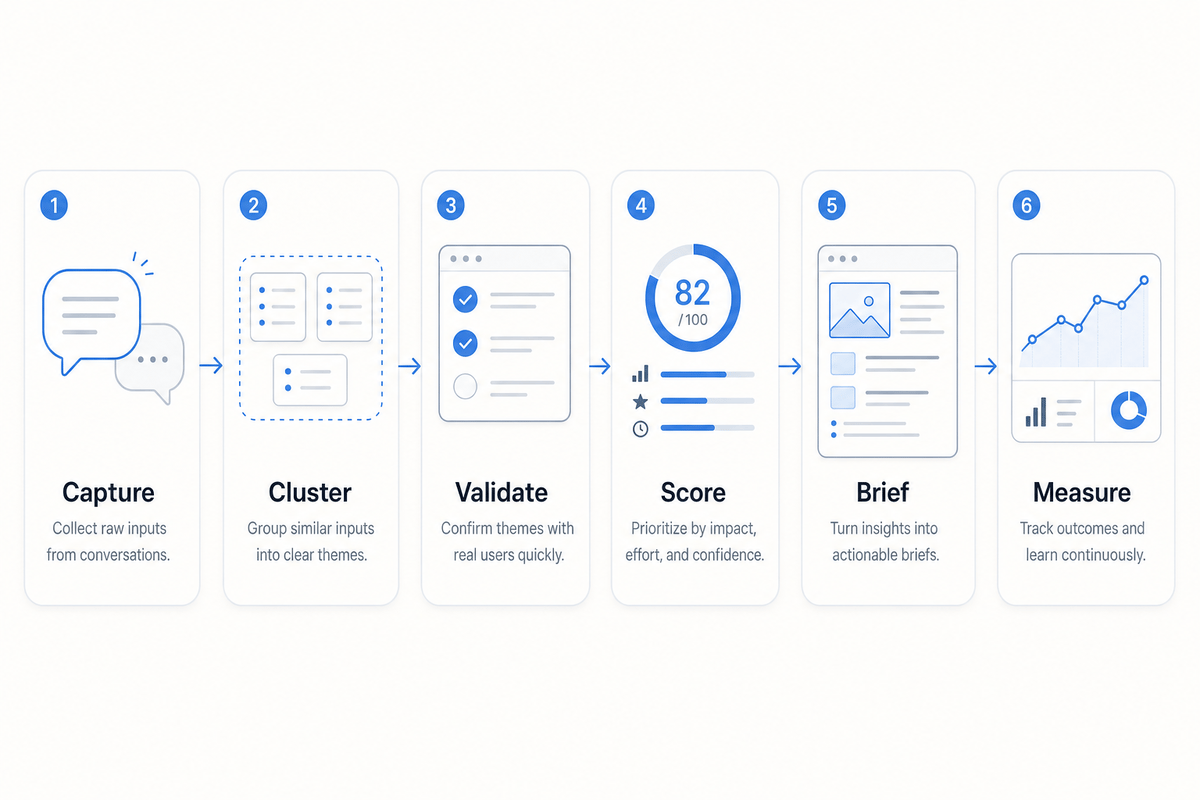
A weighted score makes tradeoffs visible. It also prevents the loudest department or largest volume estimate from deciding the calendar by default.
The scoring model
Criterion | Weight | How to score 0–3 |
|---|---|---|
Purchase intent | ×3 | From unrelated curiosity to a question that can block a purchase or next commercial step |
Frequency | ×2 | From isolated to recurring across people or channels during the review period |
Coverage gap | ×2 | From a clear existing answer to no useful public answer |
Search fit | ×2 | From account-specific and nonreusable to a clear, distinct intent that warrants a substantive page |
Answer authority | ×1 | From unverified to well-supported first-party expertise |
Multiply each 0–3 rating by its weight. The maximum is 30. As an initial operating rule, send scores of 21–30 to briefing. Ideas scoring 14–20 need more validation, bundling, or an existing-page update. Keep lower scores in the evidence log unless a strategic reason justifies the work. Calibrate those bands to your conversation volume, publishing capacity, and sales cycle.
A worked example
Imagine an inventory software company sees “Does this integrate with Shopify?” in several sales chats. The question scores 3 for purchase intent because compatibility can determine product fit, 2 for frequency, 3 for the coverage gap, 2 for search fit, and 3 for answer authority after a product owner verifies the details.
The calculation is 9 + 4 + 6 + 4 + 3, for a total of 26. It enters briefing ahead of a frequently asked beginner question that has weak commercial relevance and is already answered well elsewhere.
The score prioritizes editorial attention. It doesn’t bypass the publication gate or guarantee rankings.
The conversation behind the record
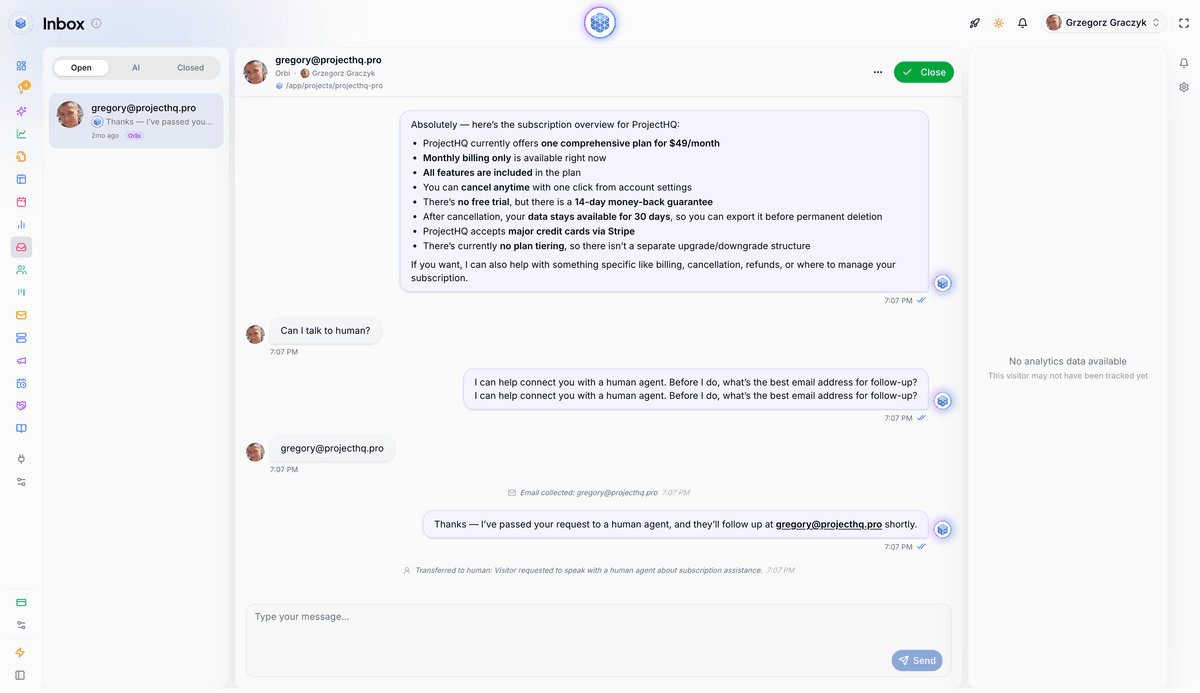
This ProjectHQ conversation shows the source evidence before editorial processing: a visitor asks about subscription terms, receives an answer, then requests a human. The transcript preserves the visitor’s wording and the handoff point. Page context, the normalized cluster, scoring, and the chosen publishing destination still belong in the editorial record described above; they shouldn’t be inferred from the screenshot alone.
Blog post, help article, FAQ, or page update?
A winning cluster still needs the right destination. Forcing every promising question into a blog post produces thin articles and leaves important conversion pages unfixed.
Destination | Use it when | Typical example |
|---|---|---|
Blog post | The question has educational or commercial search demand and needs a developed standalone answer | A comparison, framework, buyer guide, or strategic how-to |
Knowledge-base article | A customer wants to complete a repeatable task | Setup instructions or a troubleshooting sequence |
FAQ | The answer is short, stable, and broadly applicable | A simple policy or plan condition |
Product or pricing page update | The question exposes missing information at a decision point | Compatibility, implementation effort, or billing terms |
Existing-page refresh | A current URL already targets the same intent | New examples, clearer sections, or updated details |
Give a question its own blog URL when you can answer it with real depth and satisfy a distinct search intent. One cluster may also produce supporting improvements: a detailed buyer guide, a concise pricing-page clarification, and an approved knowledge-base answer can work together without repeating whole sections.
From selected question to writer-ready brief
The visitor’s words should survive the handoff to the writer. A usable brief includes the audience’s situation, exact question, verified answer, target query, search intent, required subquestions, supporting evidence, internal links, conversion path, approver, and review date.
Write the reader promise before the outline: what should someone understand or be able to decide after reading? Then put the direct answer near the beginning. A long preamble is especially costly when the original question came from someone trying to make a decision.
Use exact visitor phrases where they sound natural, especially in subheadings and examples. Shape the main title around a broader query only when that wording accurately represents the same need. Our guide to creating an SEO content brief writers can use provides a fuller structure for search intent, evidence, internal links, and conversion goals.
Once the topic and answer are approved, our AI Content Creation workflow can handle keyword research, competitor analysis, outline generation, knowledge-base context, drafting, editing, and publishing in one place. Human approval remains essential for product behavior, pricing, security, legal terms, and other details with real consequences.
Close the loop after publishing
Ranking is one part of the result. In Search Console, watch the page’s impressions, clicks, and queries. Those queries reveal whether Google associates the page with the intended question and can expose useful wording for a later update.
Measure the action the page is supposed to support as well. That could be a product-page click, form submission, or another configured event. Verify tracking before publication so you don’t discover months later that the key action was never recorded.
Finally, return to the original evidence. Are fewer people asking the same basic question? Have follow-ups become narrower? Do prospects still raise an objection the article was meant to resolve? Those observations tell you where the answer remains incomplete.
In ProjectHQ, our page-aware live chat keeps conversation history attached to contact context, while our analytics supports traffic, source, and custom-event review. Our platform connects evidence, knowledge, content production, and measurement. The weighted editorial score remains a team decision recorded in the backlog your team chooses. For the larger operating model, see our guide to connecting AI content, chat, and SEO tools.
A weekly operating rhythm for a small team
You don’t need a large research program. A short weekly review can keep the pipeline moving:
Clean new questions and preserve their source context.
Add them to existing clusters or create a new cluster.
Validate the strongest candidates in search and Search Console.
Score them and choose one brief, refresh, or page update.
Review published clusters for search performance and repeated questions.
Support or sales should own evidence quality. Content or SEO should own search validation and briefing. A subject-matter owner should approve the answer. Clear ownership keeps an appealing keyword from outrunning the facts.
Start with the last 30 days of chats, forms, and support conversations. Find one cluster tied to comparison, fit, cost, risk, or implementation, then take it through the full loop. You’ll finish with one defensible content decision and a process your team can repeat.
Grzegorz is the founder of ProjectHQ and has spent 15+ years in SEO — from technical audits to content strategy that ranks. He builds the product he writes about, so the playbooks here come from running real campaigns, not theory.
Ready to grow traffic?
Write SEO-optimized articles and track your rankings with ProjectHQ.
Get started