What Is the Best SEO Tool for Your Team? It Depends on Size and the Job
 Grzegorz Graczyk4 min read

Choose around the work your team does every week, and you can avoid paying for capabilities nobody uses. A founder publishing two articles a month needs a different setup from an agency auditing large client sites.
The short answer: there is no single best SEO tool
Roundups of top SEO tools can leave you with a lengthy list. The useful shortlist starts with two questions: who will actually log in, and what’s their primary job? Research, technical audits, rank tracking, and content production each favor different strengths.
The best SEO tool is the one that handles your main job at a cost your team can justify. For a broader comparison, see our SEO tools roundup with pricing.
Best SEO tool by primary job
Primary job | Specialist or suite pick | Starting price | Best at |
|---|---|---|---|
Research | Ahrefs or Semrush | Ahrefs Starter: $29/month; Semrush: roughly $117–$140/month, depending on plan and billing | Keyword and competitor research |
Technical audits | Screaming Frog; Google Search Console | Free; Screaming Frog paid: $259/year | Site crawling; Google indexing diagnostics |
Rank tracking | Semrush Position Tracking | Included in eligible suite plans | Daily keyword position monitoring |
Content production | Surfer or Clearscope | Surfer: $99/month; Clearscope Essentials: $189/month | Content optimization |
These USD figures come from Merchynt’s comparison and Exploding Topics’ roundup; they are secondary references without a verified price-check date here. They don't establish current vendor pricing or equivalent billing terms and allowances. Before buying, compare the plans against the same workload, including seats, keyword limits, and crawl allowances. Entry plans may not cover that workload, even when their headline prices look comparable.
Research: keyword and competitor depth
Semrush and Ahrefs are strong choices when research drives your week. Ahrefs’ $29 Starter tier is an entry point; its fuller entry plan is about $129/month. Start with free Google Keyword Planner if you’re still validating demand, and consider AnswerThePublic for question ideas.
Technical audits: finding actionable problems
Screaming Frog’s free version crawls up to 500 URLs. Pair it with free Google Search Console to investigate crawling and indexing. Then prioritize fixes against developer capacity, rather than treating every warning as equally urgent.
Rank tracking: use the tracker you already have
Semrush Position Tracking provides daily updates. A tracker inside your existing platform may cover the same practical need. Evaluate location coverage and keyword limits, and track rankings by landing page so you know which URL is gaining visibility.
Content production: optimization versus output
Shortlist Surfer or Clearscope when writers need optimization guidance. If your bottleneck is producing drafts, evaluate the drafting and review workflow separately; an optimization subscription alone doesn’t establish an editorial process.
Best SEO tool by team size
Solo founder or one marketer
Start with free Google tools plus one paid platform that addresses your biggest constraint. Buying a specialist for each of the four jobs creates four subscriptions before you know which capabilities you’ll use.
Small teams of two to ten
A platform covering audits, tracking, and content is usually the practical starting point. Add one specialist where someone regularly needs more depth. Our all-in-one versus specialist comparison explores that trade-off.
Larger teams and agencies
Specialists earn their keep when dedicated operators need deep backlink research or large-site crawling. Headcount alone doesn’t justify them; recurring work does.
A quick framework: one platform or several specialists?

Workload and depth
How many jobs happen weekly? Three or more points toward one platform.
Does one job demand specialist data? Add that specialist for a defined requirement, such as detailed backlink analysis.
Ownership and total cost
Who maintains integrations and reporting? If nobody owns that work, favor fewer tools.
What’s the monthly total? Include seats, usage allowances, and annual subscriptions divided by twelve.
The three-job threshold above is our starting heuristic, not a calculated break-even point. One demanding specialist requirement or a platform’s unsuitable usage limits can outweigh the number of jobs it covers. Our default recommendation is to consolidate, then specialize by exception. Use our guide to replacing multiple marketing tools to assess the trade-offs, then plan the connected workflow before switching.
Where ProjectHQ fits
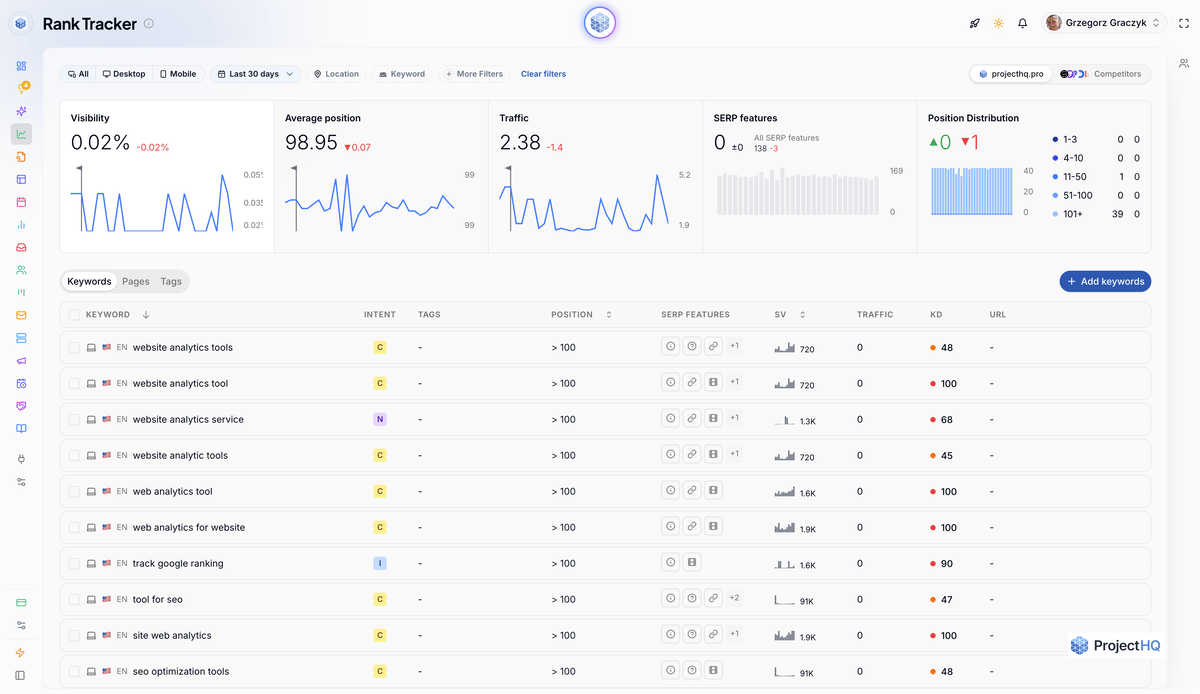
One workflow for recurring SEO work
We bring site auditing, rank tracking, and AI content into one system. Our audit crawls your site, scores its health, and prioritizes fixes. Our tracker monitors positions automatically, with trends, competitor tracking, and keyword volume, difficulty, and intent.
For content, our guided wizard combines competitor research, knowledge base integration, and SEO scoring. Our Content Planner costs $99/month per domain, everything included, with analytics, live chat, and CRM in the same system.
When to keep a specialist
If deep backlink research or crawling a very large site is your core job, pair us with a specialist. And review AI drafts before publishing, especially factual claims and product details.
For a small team handling several SEO jobs each week, start by testing your actual workflow in one platform. Add another subscription only when you can name the recurring task it handles better and the person who will use it.
Grzegorz is the founder of ProjectHQ and has spent 15+ years in SEO — from technical audits to content strategy that ranks. He builds the product he writes about, so the playbooks here come from running real campaigns, not theory.
Ready to grow traffic?
Write SEO-optimized articles and track your rankings with ProjectHQ.
Get started