How to Use AI for SEO Content Gap Analysis Without Publishing Redundant Pages
 Grzegorz Graczyk8 min read
A good content gap analysis should shrink your publishing queue. That sounds backward until you see what most gap reports contain: keyword variations, competitor topics, and unanswered questions presented as if each one deserves a URL.
For a small SaaS company, that approach creates a library full of pages competing for the same reader. AI is far more useful when it helps compare each opportunity against what you already own. The final output should be a page-level decision: create, update, consolidate, or reject.
The real output is a page decision
A content gap is an unmet reader task your company can credibly address. It might be a subject absent from the site, a question missing from an otherwise relevant guide, or a commercial comparison that your informational library never handles.
A missing competitor keyword is only a candidate. As Google’s SEO Starter Guide explains, its language-matching systems can relate a page to many query variations even when the exact terms don’t appear on the page. Publishing separate articles for “automated invoice processing” and “how to automate invoice processing” may give you two URLs doing one job.
Use AI for the work it handles well: summarizing pages, normalizing query variations, clustering similar tasks, and surfacing possible conflicts across a spreadsheet. Keep the URL decision with an editor who can assess the live search results, product relevance, and genuine difference in reader need.
Build a source-of-truth inventory first
If AI sees only a competitor export, every absent keyword looks like an opportunity. Give it a complete view of your current library before asking for ideas.
Include blog posts, feature pages, comparisons, landing pages, templates, FAQs, and knowledge-base articles. A support article may already answer a question that appears “missing” from the blog. A feature page may rank for the commercial term an SEO tool wants you to target with another post.
The minimum useful dataset
Create one row per URL with these fields:
URL, title, page type, and a two- or three-sentence summary
Primary reader task and likely search intent
Current query group, impressions, clicks, and ranking trend where available
Funnel stage, product relevance, and conversion role
Last meaningful update and editorial owner
Use page summaries or extracted body copy rather than titles alone. “Recurring billing guide” and “How recurring payments work” could be duplicates, while “Recurring billing setup” and “Recurring billing software comparison” may serve different tasks despite similar wording.
Our Site Audit can crawl and classify pages, surface duplicate-content and metadata issues, and add crawled pages to our knowledge base. That gives our AI current site context. Search performance and business value still belong in the working dataset because a crawl can’t tell you why a page matters to your pipeline. If your inventory needs cleanup first, use our content audit checklist to assign each existing URL an action.
What the inventory looks like in ProjectHQ
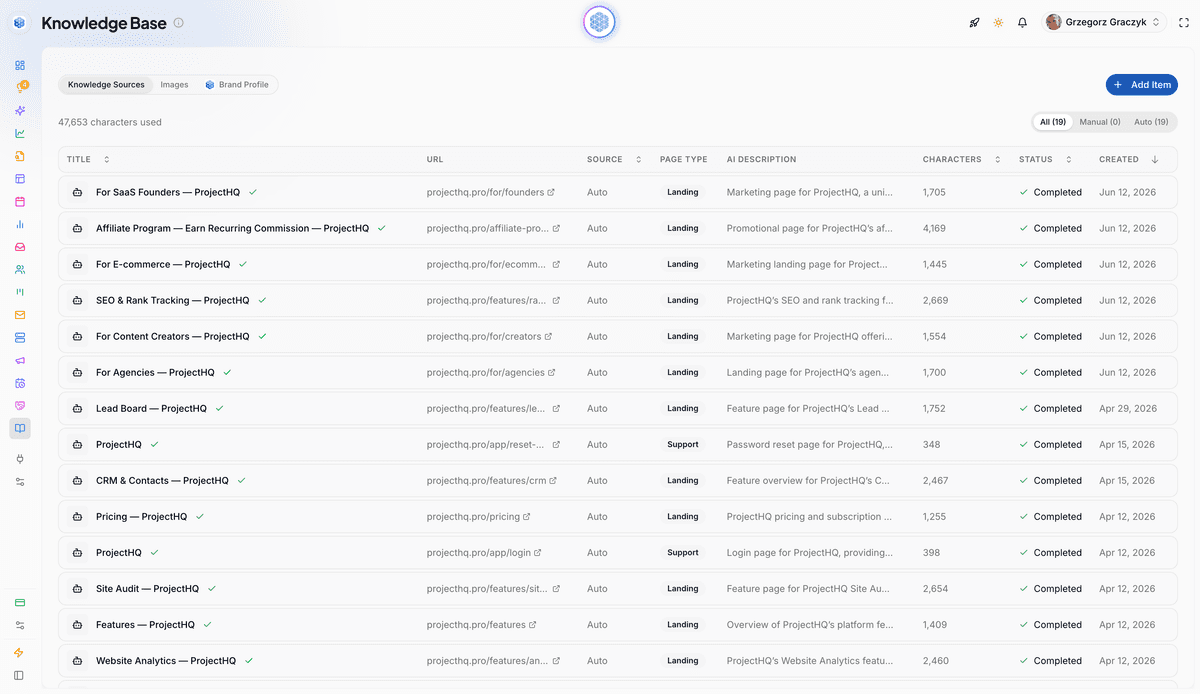
Our Knowledge Base gives the crawl-backed inventory a concrete starting point. Each source row shows the page title, URL, page type, AI description, character count, and processing status. From there, add the decision fields the crawl can’t supply: reader task, search performance, conversion role, owner, and the nearest potentially overlapping URL.
Use AI to create an intent map
Upload the inventory in batches that fit your model’s context window. Ask for a fixed output instead of an open-ended analysis. Consistent fields make the results comparable and easier to review.
Prompt: “For each supplied URL, identify the primary reader task, search intent, audience stage, topic cluster, unique scope, and nearest overlapping URL. Group synonymous queries by shared task. Assign a confidence level and quote the supplied summary as evidence. Flag uncertainty. Do not infer traffic, rankings, or product capabilities that aren’t in the data.”
Then ask the model to compare rows within each cluster and produce an overlap register containing:
The two potentially competing URLs
The task each page currently performs
The sections or promises they share
The strongest reason to keep them separate
A preliminary action and confidence level
Review low-confidence classifications manually. Semantic similarity can overmerge related pages: an implementation tutorial and a software comparison use much of the same vocabulary while supporting different decisions. It can also miss duplicates whose titles use different terminology.
The intent map should fit into a deliberate site structure. Our guide to building topic clusters for a small business website explains how to give a pillar and each supporting page a distinct job.
Add demand signals and generate candidate gaps
Now bring in external and first-party demand. Useful inputs include competitor-ranking exports, Search Console queries, live SERP formats, sales objections, and support or chat questions. Each source reveals something different. Competitor data shows market coverage; customer language shows what your buyers actually struggle with.
Ask AI to normalize those inputs into candidates. Every candidate row should include the source evidence, reader task, likely intent, expected page type, nearest existing URL, and an explanation of why that URL does or doesn’t satisfy the need.
Separate two kinds of gaps:
Page-level gap: An existing guide needs another section, example, answer, or use case.
Site-level gap: No current page can satisfy the task without changing its central promise or format.
Prioritize candidates using evidence you possess: visible demand, relevance to the product, distinctness of intent, your authority to answer, and maintenance cost. Don’t ask AI to invent search volume or assign precise opportunity scores from intuition. Give it the real inputs and let it explain the tradeoffs.
Remove ideas copied from a competitor’s strategy when they sit outside your audience or expertise. Google’s people-first content guidance asks whether a site has an intended audience and whether readers will leave able to achieve their goal. Those questions are a better filter than “three competitors wrote about it.”
The create, update, consolidate, or reject gate
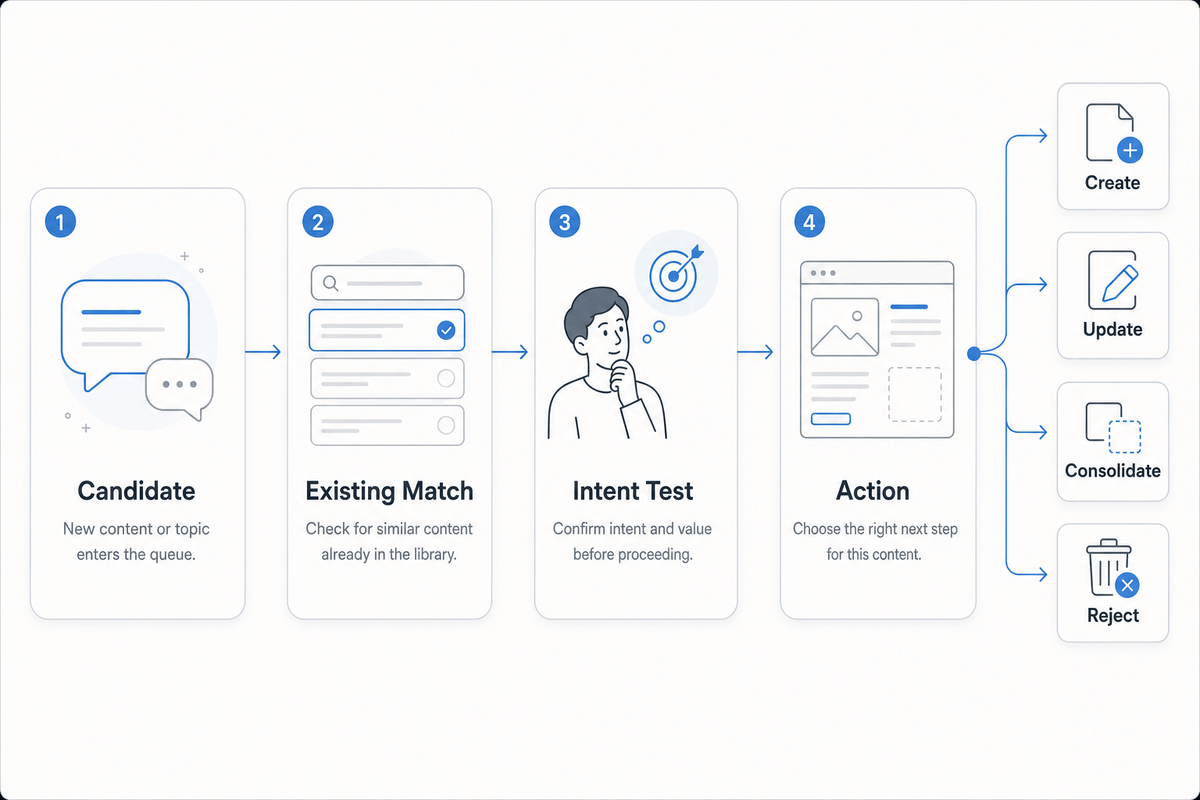
Run each candidate through the same decision table. This prevents enthusiasm for a promising keyword from quietly lowering the evidence threshold.
Action | Use it when | Common mistake |
|---|---|---|
Create | The task and likely result format are distinct from every current page. | Treating a keyword variant as a new intent. |
Update | A relevant URL already serves the intent but lacks depth, freshness, or alignment. | Starting over because updating feels less exciting. |
Consolidate | Two existing URLs substantially perform the same job. | Improving both pages and preserving the conflict. |
Reject or defer | The idea has weak audience fit, thin evidence, or no defensible scope. | Publishing because a competitor ranks for it. |
The two-query SERP test
Search the candidate query and the primary query attached to its nearest existing page. Compare the leading results, especially page type and reader task.
We use ranking-URL overlap as an editorial heuristic, not a rule: when substantially the same leading URLs appear for both queries and serve the same reader task, we first test whether one comprehensive page can cover them. Overlap alone isn’t enough. Brand dominance, a small result sample, personalization, or a mixed-intent SERP can distort the comparison. If one result set favors tutorials and the other favors product comparisons, separate pages may be justified. Record the queries, review date, leading URLs, page types, and the task each result serves so another editor can revisit the decision when the SERP changes.
Consolidation needs an implementation plan
Choose the stronger destination using relevance, performance, links, conversion value, and maintainability. Move useful material into that URL, update internal links, and permanently redirect a retired duplicate where appropriate.
Google identifies redirects and rel="canonical" annotations as strong canonicalization signals; its guidance also recommends linking internally to the preferred URL. A canonical tag can consolidate signals for duplicate or very similar URLs. It doesn’t resolve the editorial confusion of maintaining two articles aimed at the same person with the same promise.
Record the candidate, nearest URL, evidence, final action, reviewer, and review date. That decision log stops the same rejected variation from returning in next month’s AI-generated idea list.
A worked example for a 12-page SaaS library
Consider a hypothetical billing-automation SaaS with 12 marketing and help pages. Its library includes an invoice automation guide, a recurring billing feature page, an ACH-versus-card comparison, and setup documentation.
After combining competitor queries with customer questions, AI produces three apparent gaps:
Candidate | Nearest existing asset | Intent finding | Decision |
|---|---|---|---|
How to automate invoice processing | Invoice automation guide | Same instructional task and overlapping SERP results | Update the guide with the missing workflow steps |
How to recover failed subscription payments | Recurring billing feature page | Distinct operational problem requiring a process guide | Create a focused guide |
Best recurring billing tools / best recurring payment software | Recurring billing feature page | Two phrases share one commercial-comparison task | Merge into one candidate, then defer until the company can support a credible comparison |
The research batch yields one new page, one update, and no duplicate comparison posts. That is a productive outcome. The team covers more useful demand while adding only one maintenance obligation.
Turn approved gaps into briefs with hard boundaries
A page can pass the decision gate and still drift during drafting. Prevent that by making scope boundaries part of the brief.
Define the reader situation, primary query group, intent, unique promise, required evidence, conversion role, and expected format. Add two fields that most briefs omit:
Nearest existing URLs: Pages the writer must inspect before outlining.
What belongs elsewhere: Subjects this page should mention briefly and hand off to a sibling.
Those boundaries keep every supporting article from turning into a generic overview of the entire cluster. They also make internal links obvious because each excluded subject has a natural destination. Our practical guide to creating an SEO content brief provides the rest of the decision fields.
Once a candidate is approved, our AI Content Creation workflow can research keywords and ranking competitors, generate a structured outline, and draft with facts from your ProjectHQ knowledge base. Use that workflow after deciding the page deserves to exist. An editor should still review factual accuracy, original contribution, boundaries, and final internal links.
Monitor overlap after publication
Save the approved query group, intended task, nearest siblings, and baseline performance with the brief. After the page has had time to gather evidence, check whether multiple URLs earn impressions for the same query group, swap positions repeatedly, or begin covering each other’s scope.
Respond according to the evidence. Tighten a drifting page’s focus, improve internal anchors so relationships are clearer, add missing material to the stronger URL, or consolidate pages that turned out to be indistinguishable.
Google notes that some search changes take effect within hours while others can take several months, and recommends waiting at least a few weeks in general before assessing impact. Avoid diagnosing cannibalization from a few days of movement.
Start with one important product cluster. Inventory its pages, let AI build the comparison set, and approve only the candidates that survive the intent, SERP, and existing-page checks. You’ll finish with a shorter roadmap and a content library in which every URL has a clear reason to exist.
Grzegorz is the founder of ProjectHQ and has spent 15+ years in SEO — from technical audits to content strategy that ranks. He builds the product he writes about, so the playbooks here come from running real campaigns, not theory.
Ready to grow traffic?
Write SEO-optimized articles and track your rankings with ProjectHQ.
Get started